
The correct tire pressure for your car is found on a specific sticker, typically located on the driver’s side door jamb, inside the glove compartment, or within your vehicle’s owner’s manual. This recommended pressure, measured in pounds per square inch (PSI), is crucial for cold tires and directly impacts your car’s safety, handling, and fuel economy.
- Always check tire pressure when tiresare cold for accurate readings.
- Locate your car’s specific PSI recommendation on the door jamb or in the owner’s manual.
- Use a reliable tire pressure gauge for precise measurements.
- Regularly adjust tire pressure to maintain optimal performance and safety.
- Understand that tire pressure fluctuates with temperature changes.
Why Tire Pressure Matters for Every Driver
Maintaining the correct tire pressure is a fundamental aspect of vehicle care that significantly influences several critical areas of driving. It’s not merely about preventing flat tires; it’s about optimizing your car’s overall performance and ensuring a safe journey for everyone on board. Proper inflation directly affects how your tires interact with the road surface.
When tires are correctly inflated, they provide the intended contact patch, distributing the vehicle’s weight evenly across the tread. This even distribution is essential for effective braking, precise steering, and stable handling, especially during turns or emergency maneuvers. Ignoring tire pressure can lead to a cascade of negative consequences that compromise both safety and the longevity of your vehicle’s components.
Understanding Your Car’s Tire Pressure Recommendations
Every vehicle manufacturer specifies a precise tire pressure range designed for optimal performance of that particular model. These recommendations are carefully calculated based on the car’s weight, suspension, and intended use. Adhering to these guidelines ensures that the tires perform as engineered, providing the best balance of grip, comfort, and durability.
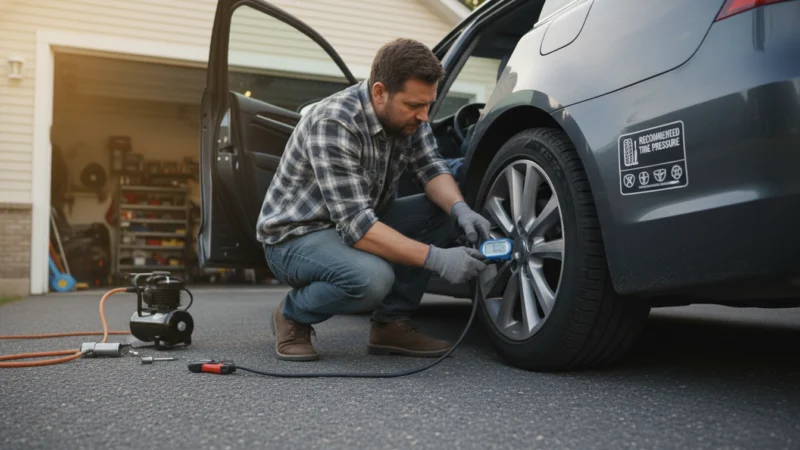
It is important to distinguish between the maximum pressure listed on the tire sidewall and the vehicle manufacturer’s recommended pressure. The sidewall number indicates the maximum pressure the tire can safely hold, not the ideal operating pressure for your specific car. Always prioritize the vehicle manufacturer’s recommendation for daily driving conditions.
Correct Tire Pressure for My Car DIY: Finding the Right PSI
Finding the correct tire pressure for your car DIY is a straightforward process once you know where to look. The most common location for this vital information is a sticker affixed to the driver’s side door jamb. This label typically includes the recommended PSI for both front and rear tires, and sometimes for a spare tire, under various load conditions.
If the sticker is missing or unreadable, consult your car’s owner’s manual. This comprehensive guide contains all the essential specifications for your vehicle, including detailed tire pressure recommendations. Always ensure you are looking for the ‘cold inflation pressure,’ as this is the standard measurement taken before driving.
Essential Tools for Accurate Tire Pressure Checks
To accurately check and adjust your tire pressure, a few basic tools are indispensable. A reliable tire pressure gauge is the most crucial item. These come in various forms, including stick gauges, dial gauges, and digital gauges, each offering different levels of precision and ease of use. Digital gauges are often preferred for their clear, exact readings.
Additionally, access to an air compressor is necessary for adding air to your tires. Many gas stations provide free or coin-operated air pumps. For convenience, a portable 12-volt air compressor can be a valuable investment, allowing you to inflate tires at home. Having a small rag or cloth can also be useful for wiping off valve stems.
Step-by-Step Guide to Checking and Adjusting Tire Pressure
Checking and adjusting your tire pressure is a simple maintenance task that can be performed in just a few minutes. Following these steps ensures accuracy and helps maintain your vehicle’s performance.
- Gather Your Tools:Have your tire pressure gauge and access to an air compressor ready.
- Ensure Tires Are Cold:For the most accurate reading, check tire pressurebefore driving or after the car has been parked for at least three hours.
- Locate Recommended PSI:Find your car’s recommended cold tire pressure on the driver’s side door jamb sticker or in the owner’s manual.
- Remove Valve Cap:Unscrew the cap from the tire’s valve stem. Keep it in a safe place to avoid losing it.
- Check Pressure:Firmly press the tire gauge onto the valve stem. A brief hiss of air is normal. The gauge will display the current PSI.
- Compare and Adjust:Compare the reading to your car’s recommended PSI. If the pressure is too low, add air using an air compressor until it reaches the correct level. If it’s too high, gently press the small pin in the center of the valve stem to release air until the correct PSI is achieved.
- Re-check and Replace:Re-check the pressure with the gauge to confirm it’s accurate. Once satisfied, replace the valve cap securely on the stem.
- Repeat for All Tires:Perform these steps for all four tires, and don’t forget to check your spare tire if applicable.
When and How Often Should You Check Tire Pressure?
Regular tire pressure checks are vital for consistent vehicle performance and safety. It is generally recommended to check your tire pressure at least once a month. This routine helps catch any slow leaks or gradual pressure loss before they become significant issues.
Beyond monthly checks, it’s also wise to check tire pressure before long trips or when there’s a significant change in ambient temperature. Temperature fluctuations directly impact tire pressure, with colder weather causing pressure to drop and warmer weather causing it to rise. Being proactive with these checks can prevent unexpected problems on the road.
Common Mistakes to Avoid When Inflating Tires
While checking tire pressure is straightforward, several common mistakes can lead to inaccurate readings or improper inflation. One frequent error is checking tires when they are hot, immediately after driving. Friction from driving heats the air inside the tires, causing pressure to increase and leading to an artificially high reading.
Another mistake is relying solely on the maximum PSI listed on the tire sidewall instead of the vehicle manufacturer’s recommendation. Over-inflating or under-inflating based on incorrect information can negatively impact handling and tire wear. Additionally, neglecting to replace valve caps can allow dirt and moisture into the valve stem, potentially causing leaks.
The Impact of Incorrect Tire Pressure: Safety, Wear, and Fuel Economy
Driving with incorrect tire pressure carries significant risks and drawbacks. Under-inflated tires can lead to increased rolling resistance, causing your engine to work harder and resulting in reduced fuel economy. They also generate excessive heat, which can weaken the tire structure and increase the risk of a blowout, a serious safety hazard.
Conversely, over-inflated tires reduce the tire’s contact patch with the road, leading to diminished traction and braking performance. This can make the vehicle feel less stable and increase stopping distances. Both under and over-inflation also cause uneven tire wear, shortening the lifespan of your tires and requiring earlier replacement.
Seasonal Adjustments: Tire Pressure in Changing Weather
Tire pressure is sensitive to temperature changes, a phenomenon that drivers should be aware of, especially during seasonal transitions. For every 10-degree Fahrenheit drop in ambient temperature, tire pressure can decrease by approximately 1 PSI. This means tires that were perfectly inflated in summer might be significantly under-inflated as winter approaches.
Conversely, a sudden warm spell can cause pressure to rise. Therefore, it’s crucial to perform more frequent tire pressure checks when temperatures fluctuate significantly. Adjusting your tire pressure to account for these seasonal shifts ensures your vehicle maintains optimal performance and safety year-round.
Beyond the Basics: TPMS and Advanced Tire Care
Modern vehicles are often equipped with a Tire Pressure Monitoring System (TPMS), which uses sensors to continuously monitor tire pressure. If the pressure in one or more tires drops significantly below the recommended level, a warning light illuminates on your dashboard. While TPMS is a valuable safety feature, it should not replace manual checks.
TPMS typically alerts you when pressure is already quite low, often 25% below the recommended PSI. Regular manual checks with a gauge provide more precise control and allow for proactive adjustments. Advanced tire care also includes regular tire rotations and alignments, which contribute to even wear and extended tire life.
Empowering Your DIY Tire Maintenance for a Safer Drive
Taking charge of your tire maintenance, particularly understanding how to find the correct tire pressure for my car DIY, is a powerful step towards safer and more efficient driving. This simple yet crucial task ensures your tires perform optimally, providing the grip, stability, and fuel economy your vehicle was designed for. Regular checks and adjustments not only enhance safety but also extend the life of your tires, saving you from premature replacements.
By incorporating these DIY tire care practices into your routine, you gain confidence in your vehicle’s condition and contribute to a more secure driving experience for yourself and others on the road. Embrace the knowledge and tools to keep your tires perfectly inflated, and enjoy the benefits of a well-maintained ride.
Frequently Asked Questions
How do I find the correct tire pressure for my car DIY?
The correct tire pressure for your car is typically found on a sticker located on the driver’s side door jamb. If it’s not there, consult your vehicle’s owner’s manual. Always look for the ‘cold inflation pressure’ specified by the manufacturer.
Can I use the PSI listed on the tire sidewall as the correct tire pressure for my car?
No, the PSI listed on the tire sidewall indicates the maximum pressure the tire can safely hold, not the recommended operating pressure for your specific vehicle. Always refer to your car’s manufacturer recommendations for the correct PSI.
How often should I check the correct tire pressure for my car?
It is recommended to check your tire pressure at least once a month, and always before long trips. You should also check it when there are significant changes in ambient temperature, as pressure fluctuates with heat and cold.
What happens if my tires have the wrong pressure?
Incorrect tire pressure can lead to several issues. Under-inflated tires reduce fuel efficiency, increase tire wear, and raise the risk of blowouts. Over-inflated tires can decrease traction, compromise braking, and also lead to uneven tire wear.
Do I need special tools to check the correct tire pressure for my car DIY?
You will need a reliable tire pressure gauge, which can be a simple stick, dial, or digital type. For adding air, you’ll need access to an air compressor, which can be found at gas stations or purchased as a portable unit.
Does the correct tire pressure for my car change with the seasons?
While the manufacturer’s recommended PSI remains constant, the actual pressure inside your tires will change with ambient temperature. Colder weather causes pressure to drop, while warmer weather causes it to rise. Therefore, you may need to adjust your tires seasonally to maintain the correct pressure.
Conclusion
Understanding and maintaining the correct tire pressure for your car is a fundamental aspect of responsible vehicle ownership, directly impacting safety, performance, and tire longevity. By regularly checking your tires when they are cold and adjusting them to the manufacturer’s recommended PSI, you ensure optimal handling, braking, and fuel efficiency. Empower yourself with these DIY maintenance skills to keep your vehicle running safely and smoothly for many miles to come.
Related Guides: How to Replace Tail Light Bulb DIY, Master How to Change Wiper Blades Easily, How To Change Spark Plugs Diy, How to Wash Car at Home Like a Professio, Mastering Windshield Washer Fluid Refill.