
Choosing the correct jack capacity is paramount for safe vehicle maintenance and repair. To select the right jack, you must first determine your vehicle’s Gross Vehicle Weight Rating (GVWR) or curb weight, then choose a jack with a capacity that can safely lift at least three-quarters of that weight, or ideally, the heaviest corner of the vehicle with a comfortable safety margin.
- Always prioritize safety by understanding your vehicle’s weight.
- Match the jack’s capacity to your vehicle’s specific lifting needs.
- Never exceed the jack’s stated weight limit.
- Use jack stands in conjunction with any jack for ultimate safety.
- Regular maintenance extends the life and reliability of your jack.
Understanding Vehicle Weight: The Foundation of Jack Selection
Before selecting any lifting equipment, a clear understanding of your vehicle’s weight is essential. This information dictates the minimum capacity required for your jack, ensuring stability and preventing potentialaccidents. Two primary weight figures are relevant: curb weight and Gross Vehicle Weight Rating (GVWR).
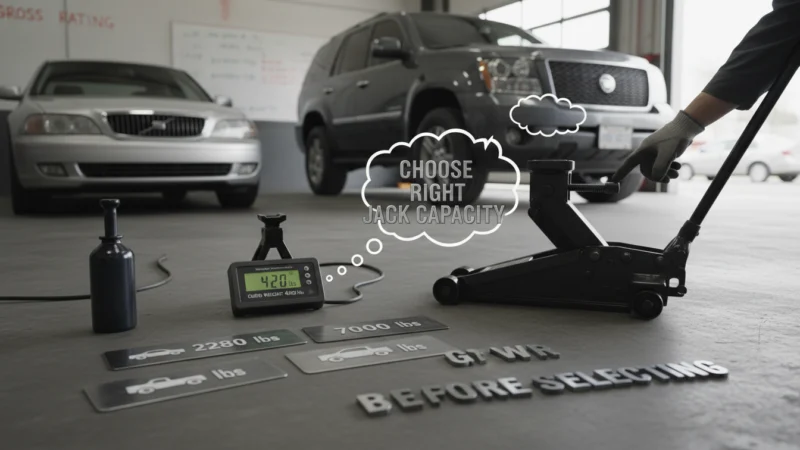
Curb Weight vs. Gross Vehicle Weight Rating (GVWR)
Curb weight refers to the total weight of a vehicle with all standard equipment, fluids, and a full tank of fuel, but without passengers or cargo. This figure provides a baseline for the vehicle’s inherent mass. It is often found in your owner’s manual or on a sticker inside the driver’s side door jamb.
The Gross Vehicle Weight Rating (GVWR) represents the maximum permissible total weight of your fully loaded vehicle, including the vehicle itself, passengers, cargo, and any accessories. While your jack won’t lift the entire GVWR at once, this figure provides a crucial upper limit for the vehicle’s potential weight. It’s a safer bet to consider GVWR when in doubt, as it accounts for the heaviest possible scenario.
Why Vehicle Weight Matters for Jack Capacity
A jack’s capacity is its maximum safe lifting load. If a jack is used to lift a weight exceeding its capacity, it can fail catastrophically. This failure can lead to severe injury, vehicle damage, or even death. Understanding your vehicle’s weight allows you to select a jack that can handle the load with a significant safety margin, ensuring stability and preventing overloading.
Decoding Jack Types and Their Capacities
Vehicle jacks come in various designs, each with specific applications and capacity ranges. Familiarizing yourself with these types helps in making an informed decision about which jack is best suited for your needs.
Floor Jacks (Hydraulic Trolley Jacks)
Floor jacks are among the most popular choices for home mechanics due to their ease of use and stability. They typically feature a long handle, wheels for maneuverability, and a hydraulic lifting mechanism. Capacities for floor jacks commonly range from 1.5 tons (3,000 lbs) to 5 tons (10,000 lbs) or more, making them suitable for a wide array of passenger cars, SUVs, and light trucks.
Bottle Jacks
Bottle jacks are compact, vertical hydraulic jacks that resemble a bottle. They offer high lifting capacities in a small footprint, often ranging from 2 tons (4,000 lbs) to 20 tons (40,000 lbs) or even higher. Their compact design makes them ideal for vehicles with higher ground clearance, such as trucks and some SUVs, but their smaller base can make them less stable on uneven surfaces compared to floor jacks.
Scissor Jacks
Scissor jacks are typically supplied as standard equipment with many vehicles for emergency tire changes. They operate via a screw mechanism that expands or contracts to lift the vehicle. While compact and easy to store, their capacities are generally lower (around 1 to 1.5 tons or 2,000-3,000 lbs) and they are less stable and slower to operate than hydraulic jacks. They are best reserved for emergency situations rather than routine maintenance.
High-Lift Jacks (Farm Jacks)
High-lift jacks are designed for off-road vehicles and heavy-duty applications, offering significant liftingheight. They operate with a mechanical lever system and can lift vehicles from various points, including bumpers or frames. Capacities typically range from 3.5 tons (7,000 lbs) to 5 tons (10,000 lbs). Due to their design, they require careful handling and are not suitable for all vehicle types or lifting scenarios.
How to Choose Right Jack Capacity: A Step-by-Step Guide
Selecting the appropriate jack capacity involves a systematic approach to ensure safety and efficiency. Follow these steps to make an informed decision for your vehicle.
- Locate Your Vehicle’s Weight Information:Check your owner’s manual or the sticker on the driver’s side door jamb for the curb weight and GVWR.
- Determine the Heaviest Corner Weight:Since a jack typically lifts only one corner or one end of a vehicle at a time, you don’t need a jack that can lift the entire vehicle’s weight. A good rule of thumb is to assume the heaviest corner of your vehicle will be roughly 60% of the curb weight divided by two (for the front axle) or 40% of the curb weight divided by two (for the rear axle), or simply one-quarter of the GVWR as a conservative estimate.
- Apply a Safety Margin:Always add a safety margin to your calculated lifting need. A common recommendation is to choose a jack with a capacity that is at least 1.5 times the heaviest corner weight. For example, if your heaviest corner is estimated at 1,000 lbs, aim for a jack with at least a 1,500 lbs (0.75 ton) capacity.
- Consider the Type of Work:For simple tire changes, a jack capable of lifting one corner is sufficient. For more extensive work that might involve lifting an entire side or the front/rear, ensure your chosen jack can handle the combined weight of that section.
- Match Jack Type to Vehicle and Usage:For low-profile sports cars, a low-profile floor jack is necessary. For heavy trucks, a bottle jack or a higher-capacity floor jack is more appropriate. Consider your typical usage – occasional emergency use versus frequent garage maintenance.
Calculating Your Vehicle’s Lifting Needs
Precise calculation helps in selecting a jack that is neither under-capacity nor excessively over-capacity, which can be unnecessarily bulky or expensive. Here’s how to approach it:

Using Curb Weight for Estimation
If your vehicle’s curb weight is 4,000 lbs, you might estimate that one corner weighs approximately 1,000 lbs (4,000 lbs / 4). To be safe, you would then look for a jack with a capacity of at least 1,500 lbs (1,000 lbs * 1.5 safety factor). This translates to a 0.75-ton jack.
Using GVWR for Maximum Safety
For maximum safety, especially if you frequently carry heavy loads, use the GVWR. If your vehicle’s GVWR is 6,000 lbs, one corner could theoretically bear up to 1,500 lbs (6,000 lbs / 4). Applying the 1.5 safety factor, you would need a jack with a capacity of at least 2,250 lbs (1.125 tons). In this scenario, a 2-ton (4,000 lbs) jack would provide ample safety margin.
Remember that the weight distribution is not perfectly even. Front-wheel-drive vehicles often have more weight over the front axle, and rear-wheel-drive or all-wheel-drive vehicles can have more balanced or rear-biased weight. Always err on the side of caution and choose a jack with a higher capacity if you are unsure.
Safety First: Essential Tips for Using Vehicle Jacks
Proper jack usage is critical to prevent accidents. Always follow these safety guidelines:
- Use on a Flat, Level Surface:Never jack up a vehicle on an incline or uneven ground. The jack could slip, causing the vehicle to fall.
- Engage Parking Brake and Block Wheels:Before lifting, ensure the parking brake is fully engaged. Place wheel chocks behind the wheels that will remain on the ground to prevent the vehicle from rolling.
- Locate Proper Jack Points:Consult your vehicle’s owner’s manual to identify the designated jack points. Using incorrect points can damage the vehicle’s frame, suspension, or undercarriage.
- Always Use Jack Stands:A jack is designed for lifting, not for holding a vehicle for extended periods. Once the vehicle is lifted to the desired height, immediately place sturdy jackstands under the designated support points. Lower the vehicle slowly onto the jack stands. Never work under a vehicle supported only by a jack.
- Never Exceed Capacity:Always verify that your jack’s capacity is sufficient for the load you are lifting. Overloading can lead to jack failure.
- Clear the Work Area:Ensure there are no obstructions or tripping hazards around your vehicle before you begin lifting.
- Avoid Working Alone:If possible, have someone nearby who can assist in an emergency.
Common Mistakes to Avoid When Selecting and Using a Jack
Even experienced DIYers can make mistakes. Being aware of these common pitfalls can help you avoid dangerous situations.
Underestimating Vehicle Weight
One of the most frequent errors is assuming a jack’s capacity based on its appearance or a vague idea of the vehicle’s size. Always verify your vehicle’s actual weight and calculate the required jack capacity precisely.
Using a Jack Without Jack Stands
This is arguably the most dangerous mistake. Relying solely on a jack for support while working under a vehicle is extremely risky. Jacks can fail due to hydraulic leaks, mechanical stress, or accidental bumps. Jack stands provide a stable, mechanical lock that prevents the vehicle from falling.
Improper Placement of the Jack
Placing a jack on an unstable surface, such as soft dirt, gravel, or a cracked driveway, can cause it to sink or tip. Similarly, using incorrect jack points on the vehicle can cause structural damage or lead to the vehicle slipping off the jack.
Ignoring Jack Maintenance
Neglecting to maintain your jack can lead to premature failure. Hydraulic jacks require occasional fluid checksand bleeding. Mechanical jacks need lubrication. A well-maintained jack is a reliable jack.
Rushing the Process
Lifting a vehicle should never be rushed. Take your time to ensure the vehicle is properly positioned, the jack is correctly placed, and jack stands are securely in position before beginning any work.
Maintenance and Care for Your Vehicle Jack
Proper maintenance ensures your jack remains safe and functional for years. Regular checks and care can prevent unexpected failures.
- Inspect Before Each Use:Look for any signs of damage, leaks, bent components, or excessive wear. Do not use a damaged jack.
- Clean Regularly:Wipe down your jack after each use to remove dirt, grease, and debris. This prevents contaminants from entering hydraulic systems or interfering with mechanical parts.
- Check Hydraulic Fluid (for hydraulic jacks):Periodically check the hydraulic fluid level according to the manufacturer’s instructions. Top off with the recommended hydraulic jack oil if needed. If the jack feels spongy or doesn’t lift smoothly, it may need to be bled to remove air from the system.
- Lubricate Moving Parts (for mechanical jacks):Apply a light coat of grease or oil to the screw mechanism and other moving parts of scissor jacks or high-lift jacks to ensure smooth operation and prevent rust.
- Store Properly:Store your jack in a clean, dry place to prevent rust and corrosion. Avoid exposing it to extreme temperatures.
When to Seek Professional Assistance
While many basic maintenance tasks can be performed at home, there are situations where professional help is advisable or necessary.
- Complex Repairs:If the repair requires specialized tools, extensive knowledge, or involves critical safety systems (like brakes or steering), it’s best left to certified mechanics.
- Lack of Proper Equipment:If you don’t have a jack with the correct capacity, suitable jack stands, or other necessary safety equipment, do not attempt the repair.
- Uncertainty or Discomfort:If you are unsure about any step of the lifting process or feel uncomfortable working under your vehicle, always err on the side of caution and consult a professional.
- Damaged Jack or Stands:Never use a jack or jack stands that show signs of damage, bending, or excessive wear. Replace them immediately or have them inspected by a professional.
Frequently Asked Questions
Why is it crucial to know how to choose right jack capacity for my car?
Knowing the correct jack capacity is crucial for safety. Using an under-capacity jack can lead to catastrophic failure, causing the vehicle to fall, resulting in severe injury or damage. It ensures the jack can safely support the vehicle’s weight during maintenance.
What’s the difference between lifting capacity and vehicle weight when considering how to choose right jack capacity?
Lifting capacity is the maximum weight a jack is designed to safely lift. Vehicle weight refers to the actual mass of your car. When choosing a jack, you need its lifting capacity to exceed the portion of your vehicle’s weight it will be supporting, plus a safety margin.
Should I always choose a jack with a capacity higher than my vehicle’s curb weight?
Not necessarily the entire curb weight, as you typically only lift one corner or one end. However, it’s wise to choose a jack with a capacity significantly higher than the estimated weight of the heaviest corner of your vehicle, often using the GVWR as a conservative basis for calculation, to ensure a substantial safety margin.
Does the type of vehicle affect how to choose right jack capacity?
Yes, the type of vehicle significantly affects the required jack capacity. Heavier vehicles like trucks and large SUVs demand higher capacity jacks (e.g., 3-ton or more), while lighter passenger cars can often be safely lifted with 1.5-ton or 2-ton jacks. Vehicle type also influences the appropriate jack style, such as low-profile jacks for sports cars or bottle jacks for high-clearance trucks.
What are the risks if I don’t know how to choose right jack capacity and use an insufficient jack?
The primary risks include the jack failing and the vehicle collapsing, which can cause serious injury, permanent disability, or even death. It can also lead to extensive damage to your vehicle’s undercarriage, suspension, or body panels. An insufficient jack is a major safety hazard.
Are there any specific calculations to help me understand how to choose right jack capacity more precisely?
Yes, a precise calculation involves taking your vehicle’s curb weight or GVWR, dividing it by four to estimate the weight on one corner, and then multiplying that figure by a safety factor of 1.5. This provides a robust minimum capacity for your jack, ensuring it can handle the load with ample reserve.
Conclusion
Understanding how to choose right jack capacity is a fundamental aspect of safe vehicle maintenance. By accurately assessing your vehicle’s weight, selecting an appropriate jack type, and always incorporating a safety margin, you can perform tasks with confidence. Remember to prioritize safety by using jack stands and adhering to proper lifting procedures. Always consult your owner’s manual for specific jack points and weight information, and never hesitate to seek professional assistance if a task feels beyond your comfort or skill level.